Philharmonic Rehearsal Hall
St. Petersburg, Russia
Ulitsa Marata 25, St. Petersburg
Acoustic planning and rehearsal-room calibration for a chamber orchestra and ensemble rehearsal hall - voicing the room for spoken cueing and calibrating monitoring levels so balance judged quietly in rehearsal still holds up at full performance volume.
The brief
- ·Rehearsals here run at every volume there is - a full tutti section needs to read clearly at something close to performance level, while ten minutes later the same room might be hosting a quiet sectional with a conductor giving notes almost under their breath.
- ·What the conductors actually asked for was trust: that a balance judged correct in a quiet coaching session would still hold up once the whole ensemble came in at full volume.
Approach
The starting point was a well-documented, slightly counterintuitive fact about hearing: the ear's sensitivity isn't flat across frequency, and exactly how uneven it is depends on how loud everything is overall. Fletcher and Munson mapped this at Bell Labs in 1933, and the equal-loudness contours that came out of it - later formalised as ISO 226 - describe precisely the gap a rehearsal room's monitoring needs to account for. At low listening levels, both the bass and the top of the treble need noticeably more sound pressure to read as loud as the midrange, which happens to be the range that carries most spoken direction and cueing.
What this meant for calibration
- ·A balance judged right at a quiet coaching level typically reads bass-light and treble-light once the full ensemble plays at performance volume, and a balance set loud sounds thin and boxy during a quiet sectional run.
- ·Turn the volume up and the contours flatten out - bass and treble close the gap with the midrange, which is why a fixed reference level matters more than it first seems.
- ·Low frequency turned out to be its own separate problem: the wavelength of a 100Hz note is roughly 3.3 metres (wavelength = speed of sound / frequency), so a full string section's lowest notes physically don't fit inside normal absorption thinking - you can't out-absorb a wave that long with a thin panel, only manage where it builds up in the room.
Solution
The room was calibrated to a fixed, consistent reference sound pressure level rather than whatever sounds right in the moment, so a balance set during a quiet sectional rehearsal holds up once the full ensemble is playing at performance level - the same principle professional monitoring rooms rely on, just applied to a rehearsal hall's actual working volume rather than its loudest moment. Fixed treatment alone couldn't solve the low end, so a set of mobile, wheeled absorption panels lets the room's effective damping change between a full-tutti rehearsal and a quiet sectional coaching session, instead of locking the hall into one acoustic personality full-time.
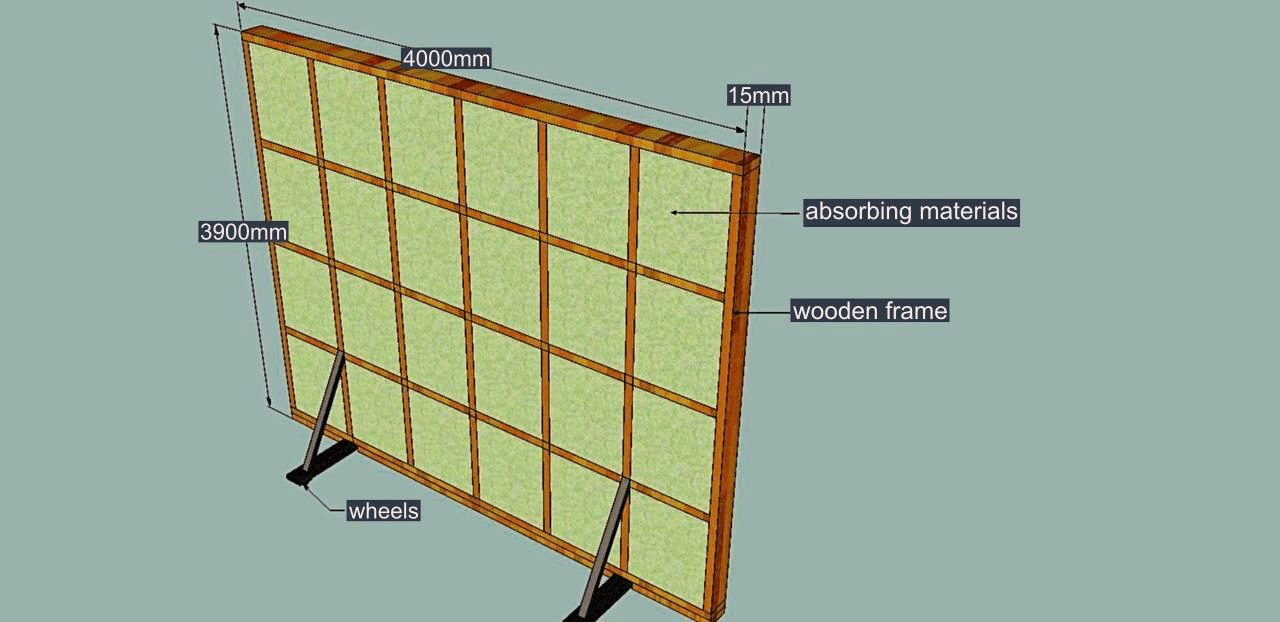
Illustrative diagram of a mobile, wheeled absorptive panel design